NONGZAO Practice • Dissolution
Project Overview
Industrial production standardises objects by eliminating difference. In exchange for efficiency, objects lose traces of their making, the marks of their processes and the possibilities of becoming something else. One way of making becomes the default, while others gradually disappear from view.
The biological properties of mycelium offer a different material order. Within the established framework of industrial production, the logic of natural growth opens up space for alternatives. A cyclical understanding of matter, rooted in agrarian civilisation, is brought into dialogue with the fixed, linear material logic of industrial civilisation.
Much of today's mycelium materials research relies on sterile laboratory environments and centralised, precision-controlled manufacturing. We are exploring another route, drawing on the sanjiu cultivation techniques of local mushroom growers to investigate the feasibility of distributed biomanufacturing. This approach remains experimental, and its viability will require continued validation through a series of field trials. The intention is to activate local production networks, accommodate the variables inherent in growth and explore a shift in social design from manufacturing to cultivating.
Dissolution is a verb. It is also a second-order dissolution: a process that breaks down existing structures and opens up new gaps.
Dissolution 001
Original Text | Xu Gang • NONGZAO Field Notes


In Guangdong, red plastic stools are almost everywhere. They stand outside small street-side shops, in village courtyards and home kitchens, and around makeshift banquet tables. They are cheap, lightweight and easily replaced when broken. People commonly call them shengdeng—literally, “economy stools”. They quietly fill the everyday lives of ordinary people.
There is little about these stools that needs explaining. Their shape has become so familiar that it is almost ingrained in our collective memory. Precisely because we know them so well, we rarely ask where they come from, let alone imagine what else they might become.
When an object becomes part of everyday life, we often stop thinking about it altogether.
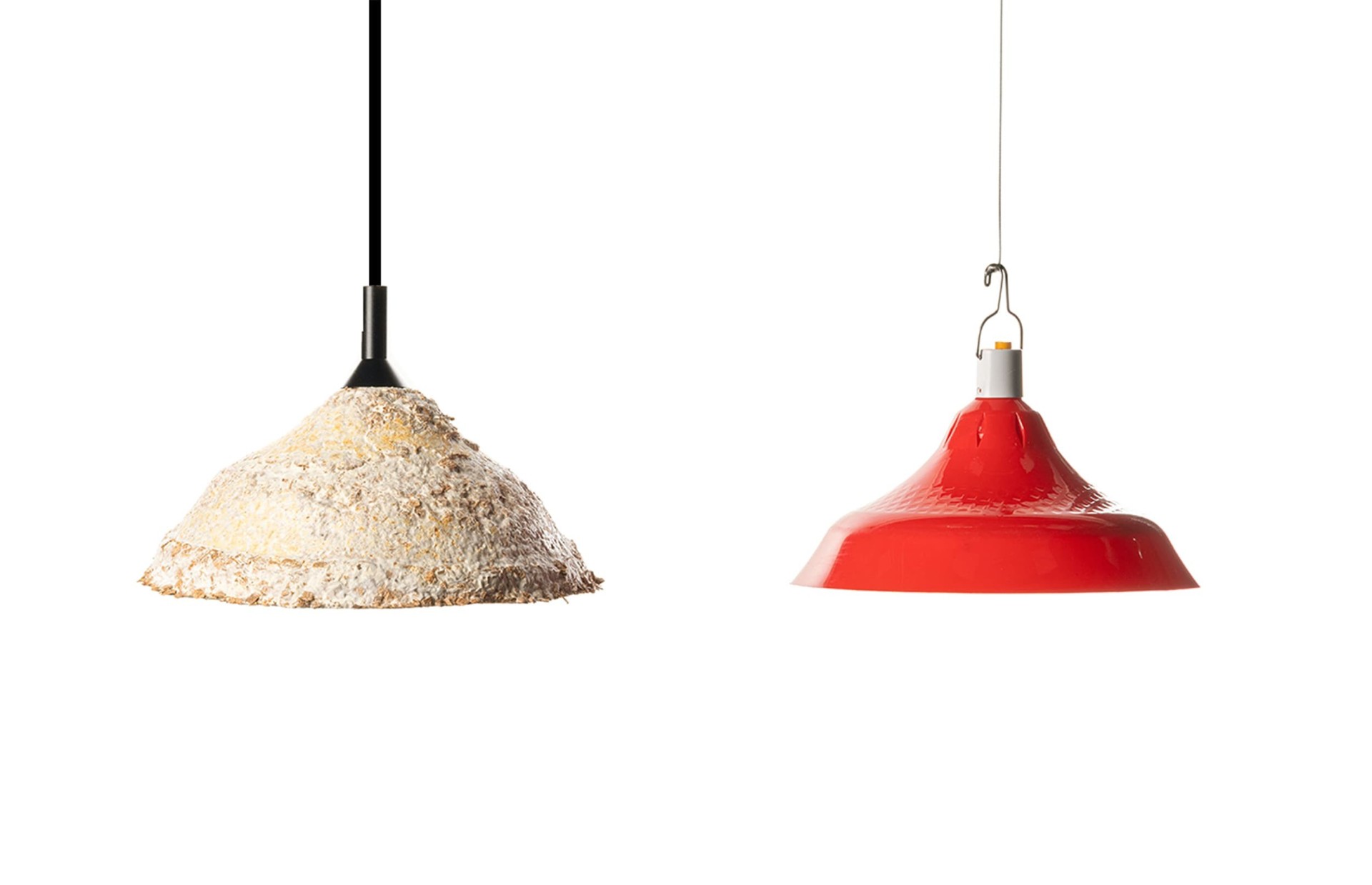
We began with one of these red plastic stools, introducing a different material into its familiar form. Using agricultural by-products as a substrate for mycelium growth, we worked with the stool's mould to allow the mycelium to spread and bind the material together. The shape remained unchanged, but the material transformed, gradually becoming a different kind of object.


01 — The Production of Sameness
Plastic is one of the most ubiquitous materials in modern life.
Lightweight, durable and easy to process, it can be rapidly reproduced in moulds and supplied to households at low cost. The red plastic stool is a small but telling expression of this productive capacity, forming part of the uniform, everyday landscape of street life across Lingnan, southern China.
This widespread availability has real value. Industrial production has made many everyday objects affordable, freeing daily life from complete dependence on expensive materials and labour-intensive craftsmanship.
But when efficiency becomes the primary measure, production develops its own momentum. What can be made easily, what can move quickly through the market and what fits existing cost structures often determine what ultimately remains in our lives.


Local materials and traditional ways of making do not necessarily disappear because they have lost their value. They may simply struggle to survive alongside production methods that are cheaper, more convenient and more standardised.
Sometimes, dissolution happens through this quiet process of substitution.
The plastic stool did not set out to eliminate other objects. It was simply useful and inexpensive enough that people gradually stopped looking for alternatives.
Rather than designing yet another stool, we chose to return to the stool itself and ask whether another relationship between form, material and manufacturing might still be possible.


02 — From Manufacturing to Growth
Mycelium offered an alternative material process for this experiment.
Mycelium is the branching, thread-like network through which fungi grow within a substrate. Under suitable conditions, it spreads through and binds together loose organic particles, gradually turning a dispersed mass into a more coherent material.
This process takes time and depends on the composition of the substrate, temperature, humidity and other growing conditions. Unlike injection moulding, which uses molten material and a mould to produce a consistent shape in a short period, mycelium develops gradually under conditions that support its growth.
In our experiment, we combined agricultural by-products with mycelium and used the mould of a plastic stool to define the material's outer shape. The mould still belonged to the existing system of industrial production, but the material inside it followed a different process of formation.


When we opened the mould for the first time, the surface was covered in a fine layer of white mycelium, like frost. Up close, it carried a faint fungal smell mixed with the earthy scent of the agricultural by-products. Pressed with a fingertip, the material felt firmer than expected, but its firmness was unlike the uniform hardness of plastic. Some areas were denser; elsewhere, small clusters of particles remained loose and only partially bound together.
There were several failed attempts. Sometimes the mycelium grew unevenly, leaving loose substrate in the middle that crumbled at the slightest touch. At other times, it grew too much, swelling inside the mould until the shape became indistinct. Each failure looked a little different, but all of them reminded us of the same thing: growth does not follow the designer's instructions completely.
The mould defined the form; the mycelium helped bind the material together. A familiar industrial object became a means of observing material growth.
Even with the same mould, mycelium composites developed different textures, densities and traces of growth. Forming was no longer simply a matter of reproducing a standard shape. The condition of the material itself also played a part in determining the result.
If manufacturing is no longer the only way an object can come into being, can design make room for growth?


03 — Another Possibility for an Everyday Object
As the mycelium gradually took on the outline of the red plastic stool, something subtly unfamiliar emerged from its familiar shape.
We could still recognise it as a stool, but it was no longer possible to understand it in quite the same way. Previously, the stool's form seemed to point directly to its function and method of production. Now, within the same outline, there was a different organisation of matter and a process of growth that could be seen in the material itself.
The shape was familiar; its origins were not. Stripped of industrial polish, it carried a quiet dignity of its own, born of natural growth.
An object we had long taken for granted became something worth looking at again. The plastic stool derives its value from accessibility, efficiency and practicality. The mycelium experiment brought the material's origins, the time required for growth and the process of forming back into view.
An object does not acquire meaning only when it is finished. How it comes into being, what it is made from and where those materials come from are equally part of what it is.
An object can be the product of manufacturing, or a form left behind by growth.


04 — Coffee Grounds: A Material Overlooked
Coffee grounds offered another line of enquiry in our material research.
Coffee has become part of everyday life for many people. Yet once the coffee has been brewed, the grounds are usually cleared away almost immediately. They are a by-product of a widely repeated daily ritual, generated continually as that ritual continues.
Rich in organic matter, coffee grounds have potential as one component of a mycelium substrate, where they can be combined with other agricultural by-products to support growth. Their moisture content, particle size, residual compounds and proportion in the mix may all affect mycelial growth and the performance of the resulting material. Each factor needs to be assessed through experimentation.


Between a cup of coffee and a stool, there is no obvious connection. Material experimentation creates the possibility of one.
Coffee grounds need not remain merely the residue of consumption. Their value lies not only in whether they can be recycled, but in whether they can play a meaningful role in a new material system.
When we begin to pay attention to everyday leftovers such as coffee grounds, flows of matter that would otherwise go unnoticed become visible. Design can begin there, too.



05 — Dissolution
This practice began with a red plastic stool, but the question it raises extends well beyond the stool itself.
An object does not have to come into being in only one way. Nor must a material remain forever in the role it was originally given.
NONGZAO is concerned with the changing relationships between people and land, materials and everyday life. Local knowledge, natural materials and making practices that have gradually been obscured by modern production do not necessarily need to return in their original forms. Through new experiments, they may find a place in contemporary life.
Dissolution is not simply an act of rejection. It is more like loosening what has become fixed: opening gaps in established forms and assumptions, allowing overlooked materials to take part in creation once again.
Dissolution is not an answer. It is a verb—a way of allowing what has been dissolved to begin growing back through the gaps.
— Practice Period: October 2023 – June 2024