
Nongzao Practice • Other Food
“Design is listening to silence.”
Original | Xu Gang • Nongzao Notes

Starting with Food
Food sustains life. It also connects us with animals. But when we think about feeding them, we often focus on nutritional formulas and established ways of eating, rarely considering how the form of food might shape an animal’s experience.
What if food could be more than something to consume? Could its shape, texture, and structure create new ways for animals to interact with it?
This practice began with these questions. Through 3D printing, we explored different forms of pet food, experimenting with materials, structures, and ways of eating. We were interested not only in whether the food could be made, but also in how its form might influence the behaviour of the animals interacting with it.

01 / Rethinking the Form of Food
The form of conventional pet food is largely shaped by formulation, processing methods, and established feeding habits. We wanted to explore whether 3D printing could open up other possibilities.
Rather than treating food as a fixed form, we approached it as something that could be reshaped. Could its geometry introduce different ways of reaching, biting, licking, or consuming it? Could the act of eating become an interaction between the animal and the object?
These questions became the starting point for our experiments. Only through making could the possibilities and limitations of an idea become clear.
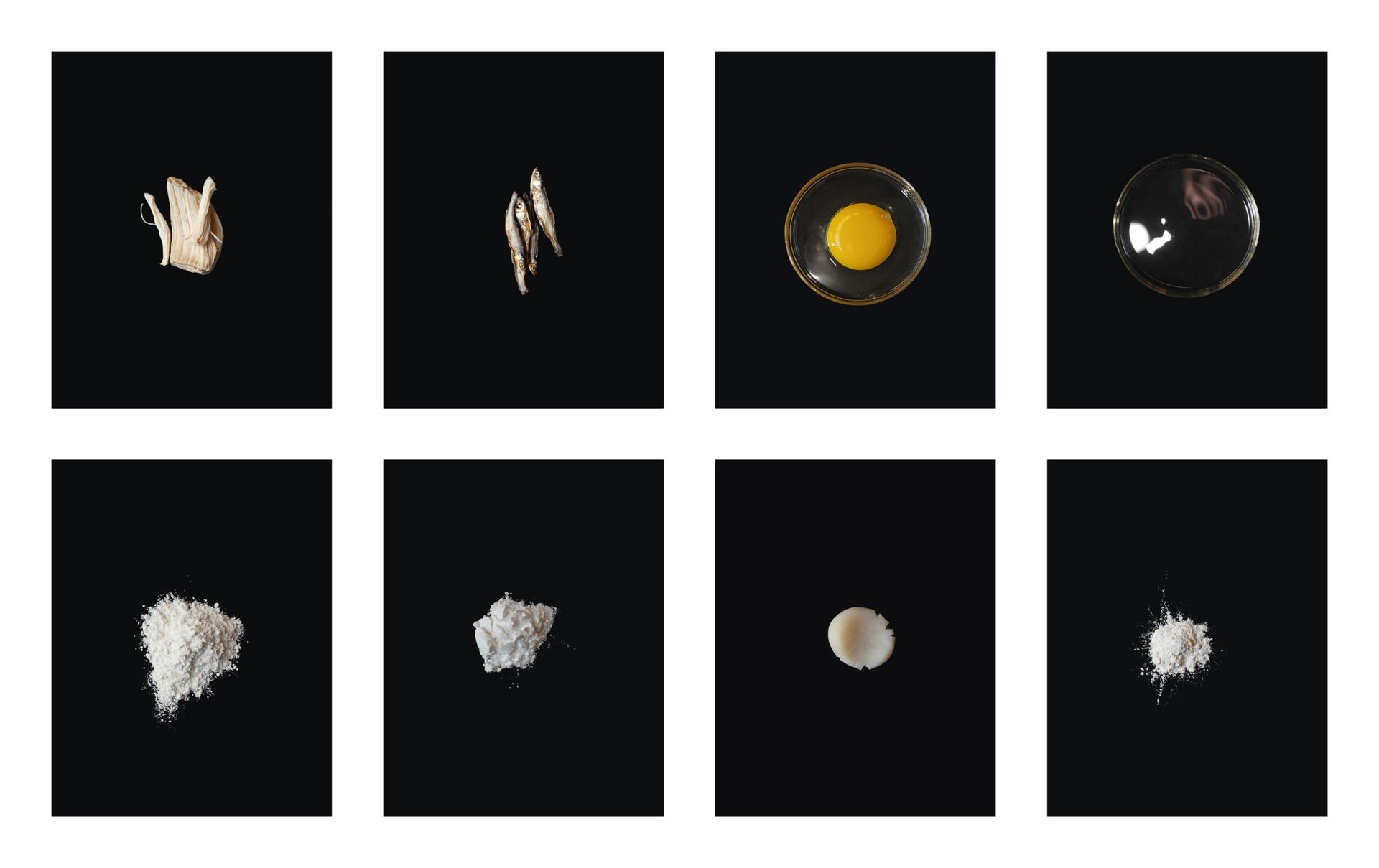
02 / Materials and Making
Material selection was an important part of the exploration. The material needed to be printable, maintain its form, and remain suitable for the intended interaction with food. Each formulation brought its own possibilities and limitations, affecting both the printing process and the resulting structure.
We experimented with different material formulations and printing parameters, observing how they affected the formation, stability, and texture of the printed objects. The process was not simply about finding a workable recipe. It was also a way to understand how material properties might shape the relationship between food and behaviour.
PHA (polyhydroxyalkanoates) are a family of polyesters produced by microorganisms. Their properties and degradation pathways vary depending on their chemical composition and the conditions to which they are exposed. Some PHA materials, including polyhydroxybutyrate (PHB), can be broken down into 3-hydroxybutyrate, a compound that also occurs naturally in the body as a ketone body.
This connection prompted us to consider whether relationships between material composition, material behaviour, and biological processes might be worth exploring further. It remains a research question, rather than a conclusion about the material’s effects on metabolism.

03 / From Feeding to Interaction
Changing the form of food also changes the conditions under which an animal encounters it.
We explored different structural configurations, observing how cats approached the food and interacted with the forms presented to them. A structure might make food easier to reach, require a different action, or create an opportunity for more sustained interaction.
These forms were not intended to dictate how an animal should behave. Instead, they offered different possibilities for action. We wanted to understand whether changing the physical conditions around food could make a difference to the way an animal engaged with it.
The experiments also revealed the limits of design. A form that appears meaningful to us does not necessarily produce the response we expect from an animal.

04 / Observing Preferences We Cannot Directly Ask About
Animals cannot explain their preferences in words. We can observe where they approach, how they eat, and how they respond to different forms, but interpreting these behaviours is another matter.
We also explored colour. Under the conditions of our tests, we did not observe a clear preference among the colours presented. This does not establish that cats have no colour preferences; it only describes what we observed in this particular experiment.
The distinction matters. An animal’s behaviour can provide clues, but a clue is not necessarily an explanation. What we see may be influenced by multiple factors, and what appears to be a preference may have another cause.
For designers, observation is only the beginning. We must also recognise the limits of what can be inferred from it.

05 / Food and Behaviour
Food is not merely an object that fulfils a biological need. The way it is presented can also shape the circumstances in which an animal interacts with it.
Through this practice, we began to consider food as a medium between material, form, and behaviour. By changing the form, we could create different conditions for interaction. But whether those conditions led to a particular experience, preference, or behavioural change could not always be determined from observation alone.
The process raised a broader question: when we design for another living being, how do we distinguish between the behaviour we observe and the meaning we assign to it?
Design can create conditions for interaction, but it cannot fully determine what that interaction means to the one experiencing it.

Unfinished Exploration
This practice began with food, but it led us to questions beyond food itself.
We explored materials, experimented with forms, and observed the responses of animals. Some ideas became tangible; others remained uncertain. The experiments did not provide definitive answers, but they made the questions more concrete.
Design is listening to silence.
Not to speak on behalf of what remains silent, but to recognise what we do not yet understand.
What we observed brought previously overlooked relationships into focus. The distance between behaviour and interpretation remains, and learning how to approach that distance will continue to be part of Agro-making’s practice.
— Practice Period: February 2024 – August 2024