NONGZAO Practice • Knowing “Flavour”, Discerning the “Way”
“This is my renewed understanding of ‘flavour’, and the position NONGZAO takes in its digital experiments with Yingjing pottery.”
Original Text | Xu Gang • NONGZAO Field Notes


In ancient Chinese thought, wei (味, flavour) was a way of discerning the Dao (道, the Way). From this association emerged the word weidao (味道), meaning flavour.
Yingjing pottery, originating in the Qin and Han dynasties in Yingjing County, Ya’an, Sichuan, belongs to this tradition of vessels shaped by flavour and everyday life. Its unadorned material character, resistance to corrosion and acids and alkalis, and chemical stability make it well suited to storing food without compromising its quality. It can be used for braising, stewing, boiling and roasting, retaining the nutritional qualities and fresh taste of ingredients. The wei of these vessels comes from the ordinary rhythms of folk life. Though simple domestic utensils, Yingjing pottery embodies a spirit cultivated through the everyday life of agrarian society—a Dao rooted in folk culture.
Whatever their material achievements, even the finest examples of traditional intangible cultural heritage remain products of the past. What has long fascinated and surprised me is something less tangible: the immaterial presence and invisible forces inherited from agrarian civilisation. In truth, both the immaterial and the invisible are embedded in folk life. As the old saying goes, “Art advances towards the Way.”
Today, calls to inherit, return to and revive tradition continue unabated. Traditional crafts are protected, historical objects collected, and local cultures reintroduced to the public through exhibitions, tourism and commercial development. These efforts have their place. Yet preserving a form does not necessarily mean that the tradition itself continues to grow.


When tradition is confined to intangible cultural heritage registers, museum display cases or tourist performances, its history may be preserved even as it gradually separates from everyday life. It can become a cultural resource to be exhibited, repurposed and consumed, while its capacity to participate in daily life and respond to contemporary needs diminishes.
In commercial adaptation, tradition can also be reduced to recognisable patterns, symbols and styles. These are reproduced, recombined and repackaged as cultural products, without necessarily carrying forward the creative intelligence embedded in the original craft and lived experience. Consumption cannot replace understanding, nor can form substitute for practice. Neither, on its own, constitutes a revival of culture.
Yet the opposite tendency deserves equal scrutiny: placing tradition beyond question, imagining agrarian civilisation as inherently pure, wise and complete, while treating modernity as a force that brings only pollution, alienation and decline.


Traditional agrarian civilisation holds accumulated knowledge and wisdom, but also limitations imposed by the conditions of its time. Modern technologies can produce new forms of alienation, yet they can also open up possibilities for practice that were once difficult to imagine. The relationship between the two need not be an either-or choice.
Tradition should neither become the material for a new mythology nor be treated as a burden that modernisation must cast off. What matters more is understanding how it came into being, why it has endured, which of its accumulated experiences remain valuable, and whether these can continue to evolve under new conditions.
For NONGZAO, such understanding cannot remain at the level of cultural interpretation. It must enter into materials, processes and the actual work of making, where it can be tested through practice.


Digital Experiments: Seeking Another Relationship Between Tradition and the Present
Every era has its own technological conditions and its own questions that need to be reconsidered.
The development of data and computational technologies is changing how we acquire knowledge, organise production and create. As new technologies, materials and methods of fabrication increasingly intersect, can they help us understand traditional crafts anew? Beyond documentation, preservation and improvements in efficiency, might there be other possibilities for a relationship between digital technology and traditional knowledge?
Industrialisation expanded the scale of material production, making standardised products accessible to more people. Information technology has transformed how knowledge is circulated and acquired. At the same time, mass production and standardisation can compress differences, while digitalisation does not necessarily lead to richer understanding. How might a new relationship be found between standardised production and individual variation? Could different combinations of technologies open up new paths for elements that are difficult to accommodate within existing systems of production?
Design can solve problems, but its role extends beyond that. It can also be a form of inquiry: through making, testing and comparison, it gives possibilities that have yet to be established a chance to be examined. The value of design lies not in providing immediate answers, but in raising new questions and creating new relationships.
The digital experiments with Yingjing pottery began with these thoughts. They were never intended simply to reproduce a traditional craft through digital technology, nor did they assume that technological intervention would necessarily produce better objects. Instead, they asked what might happen to established craft practices and ways of making when algorithms, materials, fire and human experience enter into new relationships.


01 / Letting Algorithms Encounter Uncertainty
During the traditional firing of Yingjing pottery, craftspeople observe the colour of the flames, listen to the sounds within the kiln, and draw on years of accumulated experience to judge the state of the firing. Temperature and time are certainly important, but many factors in actual practice remain difficult to quantify fully. Bodily knowledge and judgement in the moment are part of the craft itself.
We recorded the entire firing process, from ignition and temperature rise through holding, cooling and opening the kiln. Particular attention was paid to departures from expectations, including temperature fluctuations, uneven cooling and localised over-firing. These data were then introduced into the algorithmic generation process, allowing it to move beyond stable, predictable firing conditions and generate firing curves that deliberately departed from conventional practice.
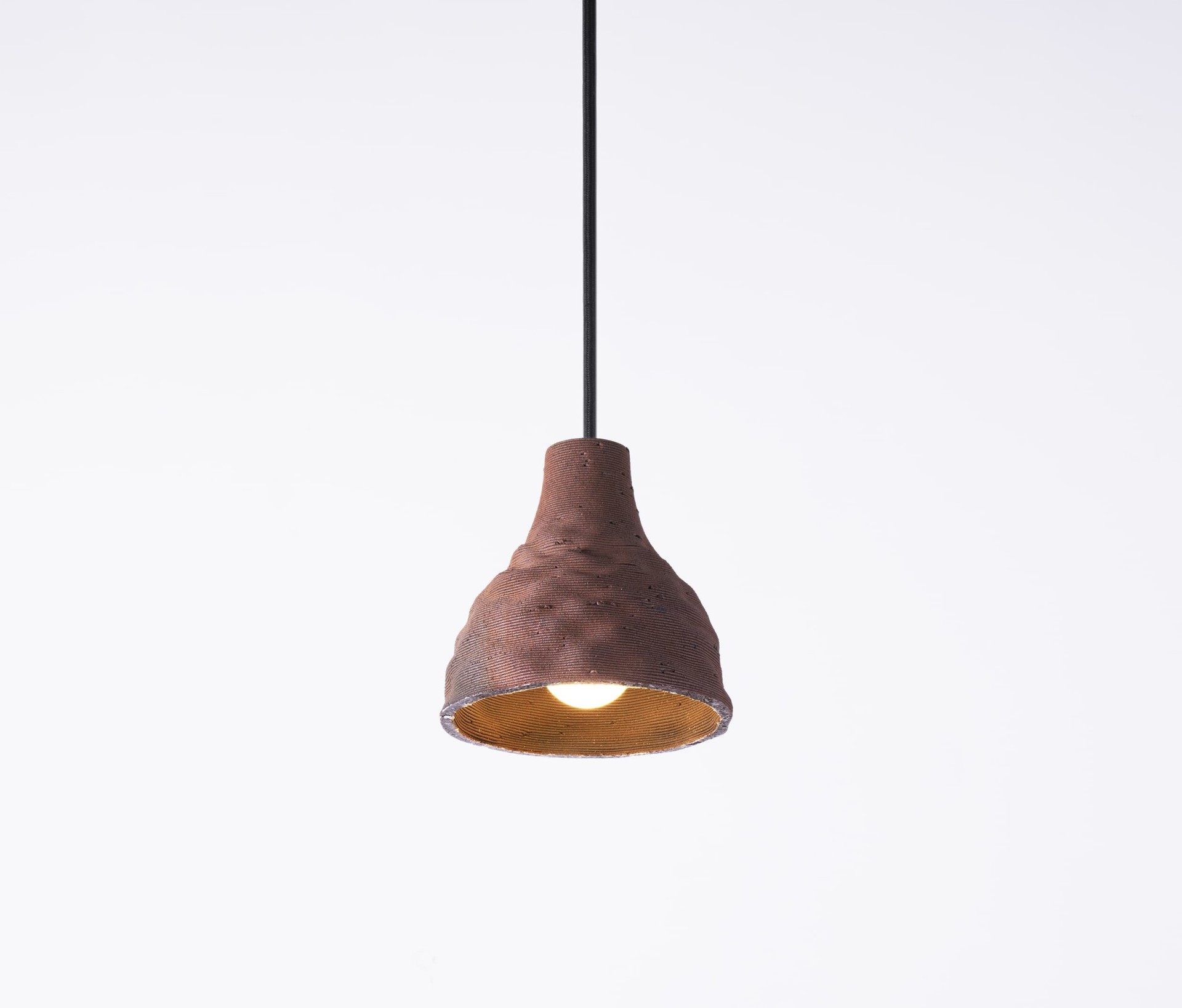
The resulting curves followed different logics from those of conventional firing and were then tested in actual kiln firings by craftspeople. During the process, fire, material and conditions within the kiln interacted, producing surface changes that could not be fully determined in advance.
These changes cannot simply be classified as defects in the traditional sense, nor are they equivalent to visual effects controlled in advance through predetermined parameters. They suggest that when digital systems enter traditional craft practices, the outcome need not always move towards greater precision and stability.
This was not an attempt to optimise traditional craft, but an experiment in departing from established paths. It asked whether deliberately introducing uncertainty might reopen aspects of the process that are usually treated as deviations and excluded.


02 / When Objects No Longer Serve a Purpose
Through generations of use and adaptation, the traditional forms of Yingjing pottery have developed in close relation to everyday life. Clay pots are used for cooking, jars for storage, and basins for other domestic tasks. Over time, the forms, materials and uses of these objects have settled into established relationships through sustained practice.
These relationships are not simply a matter of form following function. They also embody the mutual adaptation of local materials, craft processes, habits of living and accumulated experience of use.
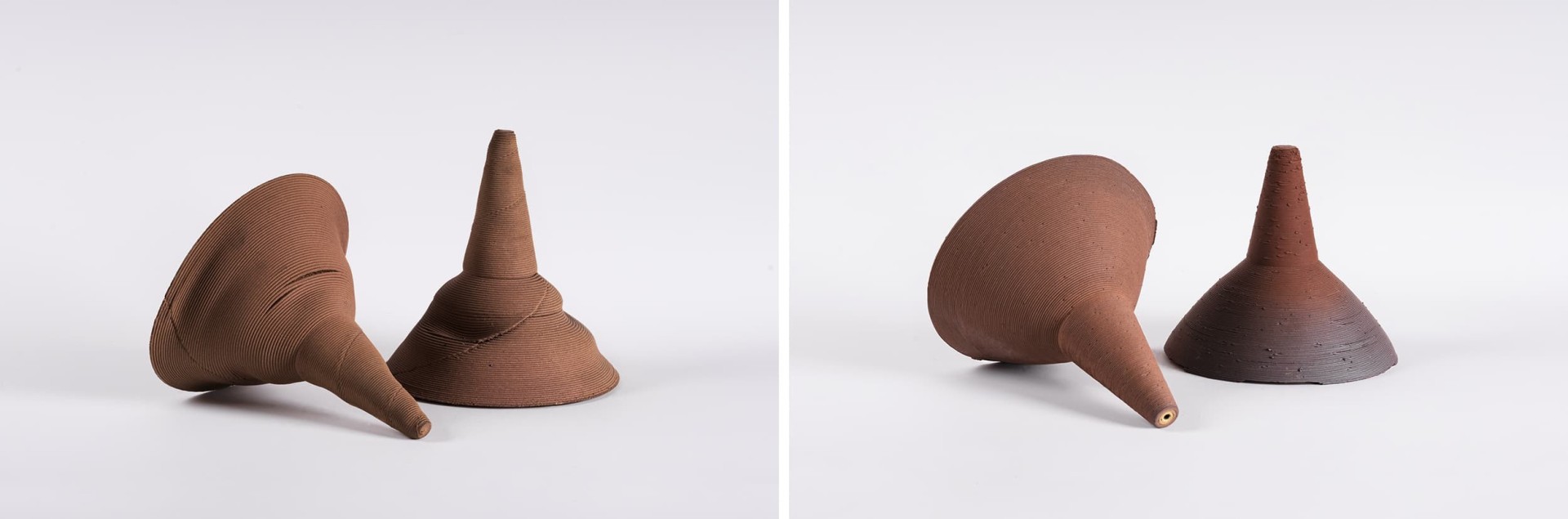
We extracted formal characteristics from traditional vessel types and used algorithms to generate a series of forms that departed from their established rules. These forms were produced through 3D printing before entering the traditional firing process used for Yingjing pottery.
They retain certain visual and material qualities of traditional pottery, yet resist classification as familiar objects such as pots, jars or basins. Nor do they have any clearly defined practical function. They cannot be used to stew food, store water or hold grain. Rather than directly reproducing traditional vessel forms, they reorganise the rules through which those forms have been established.
When a vessel no longer serves a clearly defined purpose, what remains?
Is it the character left by its material and making process? The cultural associations that traditional objects evoke? Or a form detached from the relationships with everyday life that once gave it meaning?


03 / Can Data Re-enter Bodily Experience?
The transmission of traditional craft often depends on working together over long periods, learning through demonstration and instruction, and developing skills through bodily practice. Many judgements do not exist as explicit rules. They emerge through repetition: the fingers sensing the condition of clay, the adjustment of movement and pressure, and the judgement of heat and timing.
Digital technologies are often used to document this knowledge by scanning objects, recording processes and capturing movements. Yet the information recorded is not equivalent to the craft itself. Data can preserve traces of a particular movement or state, but may not fully express what a craftsperson felt and judged at the time, or the experience underlying that judgement.
One direction of this exploration was to shift digital documentation from one-way preservation towards interaction with practice.
Within the craftsperson's workspace, we explored recording the entire process—from kneading clay, throwing and trimming forms to loading and opening the kiln—using temperature and humidity sensors, motion capture and audio recording. We also explored ways of feeding some of this information back to the craftsperson in real time.
The data was not intended to determine whether a movement was correct, nor to identify an optimal sequence of operations. Instead, it offered another mode of perception, allowing information that might otherwise go unnoticed to re-enter the making process.
The craftsperson could adjust their movements in response to the feedback, or simply disregard it. The system was not there to replace their judgement, but to offer another way of relating to their own practice.
Such intervention might not make the process faster. It could even interrupt the established rhythm of movement, introducing hesitation into familiar operations. The question was not whether this feedback could improve efficiency, but whether the relationship between people and craft might change when bodily experience and digital technology came together.
Data cannot become craftsmanship in itself, but neither must it remain confined to documenting craft. Could it participate in the formation of experience through new forms of feedback? This remains an open question, one that requires further exploration.




04 / Beyond the Established Track
The digital experiments with Yingjing pottery have yet to arrive at a definitive conclusion about function, or a technical conclusion capable of encompassing their full significance.
This does not mean that the experiments do not need results. Results need not take the form of a finished product, an optimised set of parameters or a reproducible craft process. An experiment can help us recognise the limits of existing understanding, discern relationships between factors that have yet to be understood, and formulate new questions for subsequent practice.
Across the experiments, algorithms were made to encounter uncertainty, vessels were temporarily released from predetermined uses, and data was allowed to enter the craftsperson's bodily experience in different ways. Together, these explorations point towards a shared question: can traditional craft continue to change and generate new knowledge under new technological conditions?
By “another track”, we do not mean opposing tradition, nor pursuing outcomes simply because they contradict established practice. It means temporarily leaving behind paths that have already been validated, working in directions whose outcomes remain uncertain, and accepting the possibility of failure, deviation and the unexpected.

The continuation of tradition involves more than preserving what has already been achieved. It also means allowing it to enter contemporary practice and generate experience and knowledge through new relationships. Whether these explorations will ultimately lead to new crafts, new objects or a renewed understanding of existing questions cannot be determined in advance.
What matters is that tradition need not remain confined to a history already completed. It can continue to enter the present and encounter the unknown.
— Practice Period: December 2020 – August 2021